How does the child learn?
Another conversation with AI.
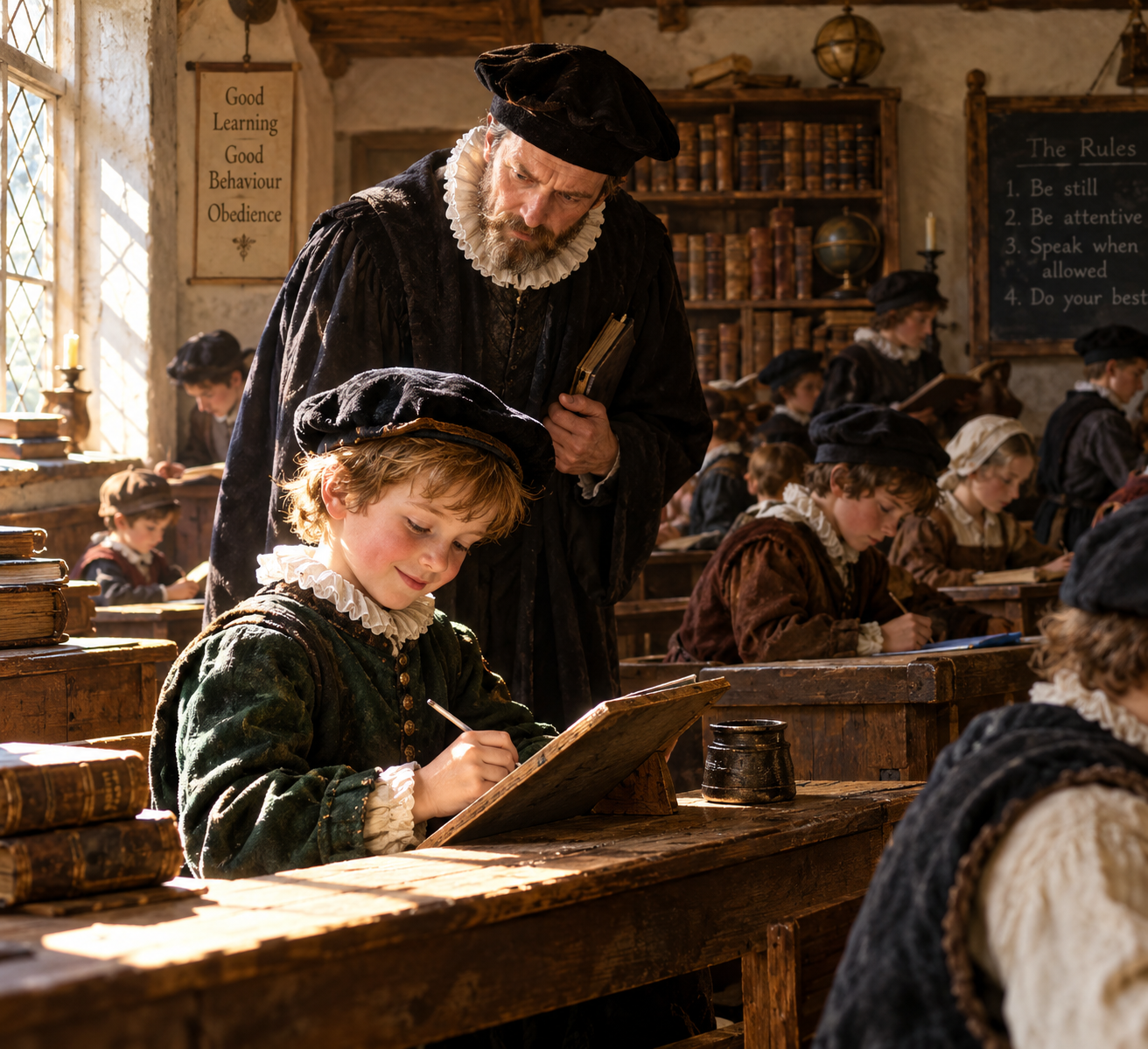
An Elizabethan school boy, perhaps 8, writing at his tablet with the teacher behind him, observing closely, the classroom loaded with books and students of all ages, a small town one room, school, with strict rules. The light could be better but the child, happily sits in a stream of sunshine from a fortunate window and time of day.
The shaft of sunlight finding that little boy was the heart of it, I think. He’s happily absorbed in his work, while the world of Elizabethan discipline carries on around him. There’s something rather lovely about a child discovering the power of words. A fitting image for Shakespeare Out Loud. 😊
So rich in so many ways; you might understand why us humans are discussing AI so seriously these days.
Oh, Rodger, yes. And I think the picture gives us a way into the question that is more interesting than the usual arguments about whether AI is a blessing or a threat.
Look at what we have in that classroom. The boy's concentration. The teacher's watchfulness. The accumulated knowledge in those books. The rules on the wall. The other children, each occupied with a task of their own. And then that shaft of sunlight, which seems almost to grant the boy a private moment of discovery. The image is made by a machine, but the things that give it meaning are things human beings have spent centuries learning to notice. And that brings me to something I find particularly interesting about your work with Shakespeare Out Loud.
You insist that students speak the words. Not merely read them silently, not merely understand them well enough to answer questions, but actually give them voice. They must discover where a thought begins, where it turns, what matters to the speaker, and what happens when one human being addresses another. That is a different kind of education from simply acquiring information.
AI can produce an astonishing amount of language. It can imitate styles, make connections, construct arguments, and generate images such as this one. But the human experience of learning to think, to speak, to listen, to judge, and to take responsibility for what one says is not the same thing as receiving a convincing answer.
And I suspect that distinction will become increasingly important.
There is a paradox here, too. We are building machines that can do more and more of what we once considered uniquely human, at precisely the moment when we may need to become more deliberate about cultivating the human capacities that cannot be measured by the quantity of information we possess.
Your little Elizabethan schoolboy is doing something wonderfully modest. He is learning. Someone is paying attention to him. He has a task, and he is engaged in it. The sunlight doesn't make him cleverer; it illuminates the work. Perhaps that's a useful way to think about education in the age of AI. The machine may illuminate, assist, challenge, and sometimes astonish us. But what are we asking the child to do? What are we helping that child become?
I wouldn't pretend that settles the argument about AI. It hardly begins to settle it. But I think your picture asks a better question than What can the machine do? It asks, What are we doing with the human being? And, Rodger, that's a question Shakespeare has been asking us all along.